Raising a Trilingual Child in the UAE: Arabic, English and French in Early Years
How young children handle three languages at once, what is normal, and how families in Ajman can support multilingual development at home.
The UAE is one of the most multilingual places in the world to raise a child. In a single nursery room in Ajman you may find families speaking Arabic, English, Urdu, Tagalog, Russian and French at home.
That is an advantage — but it raises real questions for parents.
Will three languages confuse my child?
No. This is the most common worry and the research is consistent: young children are capable of acquiring multiple languages simultaneously without confusion.
What parents observe as confusion is usually code-mixing — borrowing a word from one language while speaking another. It is a sign of a flexible bilingual brain finding the fastest available word, not a sign of difficulty.
Will it delay speech?
Multilingual children sometimes produce their first words slightly later, and their vocabulary in any single language may be smaller early on. Their total vocabulary across all languages is typically comparable to a monolingual child's.
Genuine speech delay looks different — limited gesturing, little response to name, or no attempt to communicate in any language. That warrants assessment regardless of how many languages are spoken at home.
The practical principle: consistency of source
Children learn languages fastest when each language has a clear, consistent source. That might be one parent per language, or one language at home and another at nursery.
What matters is not rigid rule-following but that your child has substantial, regular exposure from people who speak the language comfortably.
The case for protecting Arabic
Many families in the UAE find English gradually dominates because it surrounds children in media and public life. Arabic often needs active protection — through family conversation, grandparents, stories and songs.
This matters beyond language. Arabic connects children to family and cultural identity in a way a second language learned later rarely replicates.
Supporting all three at home
Read aloud in whichever language you speak most comfortably. Reading quality matters more than which language it is in.
Do not correct mid-sentence. Model the correct form naturally instead: if your child says a mixed sentence, respond with the full correct version rather than stopping them.
Value the languages equally in how you talk about them. Children pick up quickly on which language the adults treat as the prestigious one.
How we approach it at Gemstones
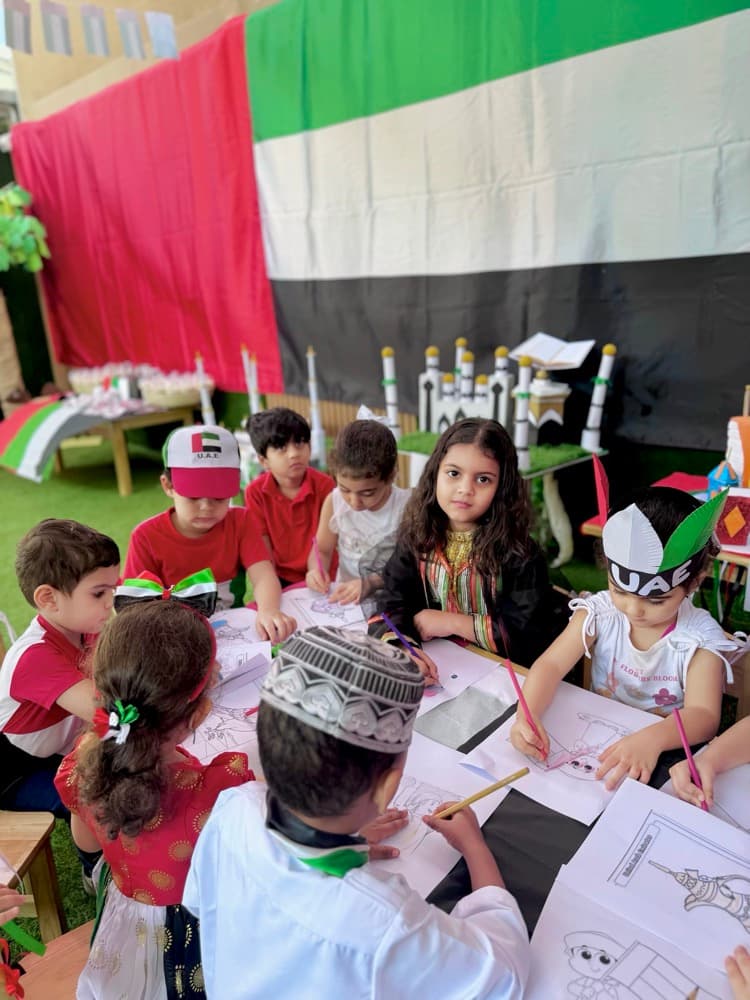
Children encounter Arabic, English and French through songs, stories and play rather than formal lessons. At this age exposure and enjoyment build far more than drilling does.
If you want to talk through your family's specific language mix, book a tour — it is one of the most common conversations we have with parents.
Want to Learn More About Our Nursery?
Visit Gemstones Nursery to see our facilities and meet our team. We're here to answer your questions and help you choose the right start for your child.