The British EYFS Curriculum Explained: What It Means for Your Child
A plain-English guide to the Early Years Foundation Stage framework used in UAE nurseries, and what progress actually looks like at each age.
If you have toured nurseries in Ajman, you have almost certainly been told that the nursery follows the British EYFS curriculum. It is one of the most repeated phrases in early years marketing and one of the least explained.
Here is what it actually means.
What EYFS is
The Early Years Foundation Stage is the statutory framework used in England for children from birth to five. It is not a syllabus of facts to memorise. It is a structure describing how young children learn and what adults should provide to support that.
The seven areas of learning
EYFS splits development into three prime areas and four specific areas.
The prime areas come first because everything else depends on them:
- Communication and language
- Physical development
- Personal, social and emotional development
The specific areas build on that foundation:
- Literacy
- Mathematics
- Understanding the world
- Expressive arts and design
A good nursery does not teach these as separate subjects. A single activity — baking, for instance — covers mathematics through measuring, language through instruction, physical development through mixing, and personal development through taking turns.
Why play is treated seriously
Parents sometimes worry that play-based means unstructured. Under EYFS the opposite is true. Play is the method, not the absence of one. Staff plan deliberately, observe closely, and step in to extend a child's thinking at the right moment.
The framework identifies three characteristics of effective learning: playing and exploring, active learning, and creating and thinking critically. These describe how a child learns, which matters far more at this age than what facts they can recite.
What progress looks like
By around two, you are looking for growing vocabulary, interest in other children, and increasing physical confidence.
By around three, you should see longer concentration, more complex pretend play, and the beginnings of self-regulation.
By four, most children show early mark-making, an understanding of number as quantity rather than just counting words, and the ability to manage simple social conflict with support.
Children do not move through this in a straight line. A child may leap ahead in language and take longer with physical confidence. That is normal and a good nursery will tell you so rather than worry you.
Questions to ask a nursery about EYFS
How do you record observations, and how often will I see them?
Can you show me how one week's plan connects to the seven areas?
What happens if my child is behind in one area?
The answers reveal whether EYFS is genuinely embedded or simply printed on the brochure.
EYFS in a trilingual setting
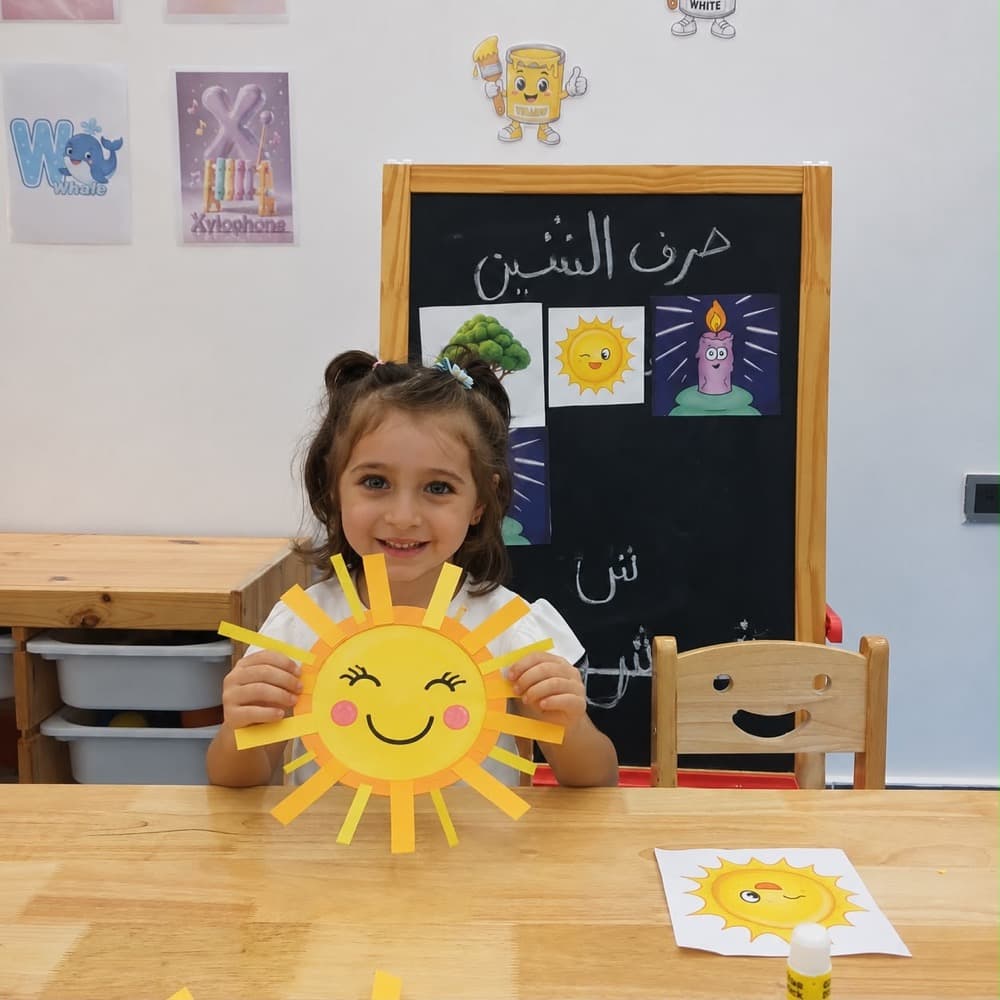
At Gemstones, children encounter Arabic, English and French. Research consistently shows that early multilingual exposure does not delay language development; children may mix languages temporarily, which is a normal stage rather than a problem.
If you would like to see how the framework works in practice, book a tour and ask to see real observation records.
Want to Learn More About Our Nursery?
Visit Gemstones Nursery to see our facilities and meet our team. We're here to answer your questions and help you choose the right start for your child.